
How to Pass a Prop Firm Evaluation on NQ: Drawdown Maths for Beginners
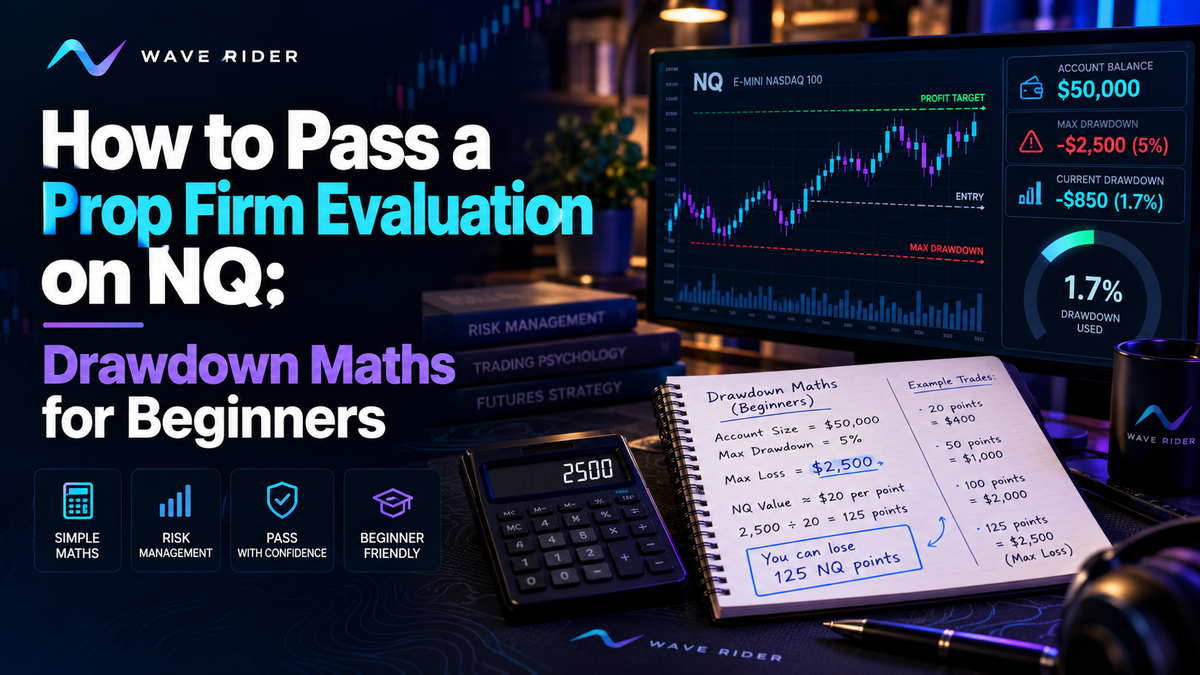
Most people do not fail prop firm evaluations because their strategy is bad. They fail because one bad day breaks the drawdown rule.
Get the maths right first and the evaluation becomes far easier.
The two numbers that matter
Every evaluation has a profit target and a maximum drawdown. The drawdown is how far your account can fall before you fail. Some firms also have a daily loss limit.
Your job is not to hit the target fast. Your job is to never touch the drawdown.
Start with risk per trade
Decide how much you will lose if a trade hits its stop. Then work out how many losing trades in a row your drawdown can absorb.
A simple example on a $50k account with a $2,000 drawdown:
- Risk $400 a trade and five losses in a row fails you
- Risk $200 a trade and you can take ten
- Risk $100 a trade and you can take twenty
Five losses in a row happens to every trader. Twenty is much rarer.
Turning risk into contracts on NQ
- NQ (the full size contract) moves $20 per point
- MNQ (the Micro) moves $2 per point
If your stop is 25 points away on MNQ, each contract risks $50. Four Micros risks $200.
This is why most beginners should start on Micros (see MNQ vs NQ for beginners). You can size precisely instead of being forced into big risk by one large contract.
Check the drawdown type
Firms use different drawdown rules. Some trail your highest balance during the day. Others only update at the end of the day. Some stop trailing once you reach a set level. Read the rules for your exact account before your first trade (our prop firm comparison covers what to check), because the same strategy can pass on one and fail on another.
A real example of drawdown in practice
Over the last twelve months, the Wave Rider strategy on NQ risked a maximum of $300 per trade. Its deepest drawdown across the whole year was $3,895. That is the kind of number you plan around before choosing an account size and risk level.
Five rules for passing
- Fix your risk per trade before you start, and write it down
- Stop trading for the day after a set number of losses
- Do not increase size to "make it back"
- Trade the same setup every time
- Treat the evaluation like a funded account, not a lottery ticket
In the mentorship, every member gets a written risk plan sized to their own firm's rules before they take a live trade.
Get your prop firm risk plan in the mentorship
Strategy results come from Wave Rider on TradingView, 30 Sep 2025 to 1 Oct 2026, and are not a guarantee of future results. Trading futures carries a substantial risk of loss. Education only, not financial advice.
Want to learn this with a mentor?
Join the Wave Rider Mentorship: live NQ sessions, a simple playbook, prop firm training and the Wave Rider indicator included.
Join the mentorship → See the 12 month resultsCharting and analysis only — nothing here is financial advice. Trading involves substantial risk of loss.